admin
admin
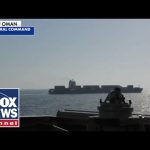
On April 19, 2026, U.S. forces disabled and seized an Iranian-flagged cargo ship identified as the M/V Touska after the guided-missile destroyer USS Spruance fired into the vessel’s engine room and American Marines took custody. The decisive action followed repeated warnings to the ship’s crew and was presented by commanders as a necessary enforcement of the naval blockade meant to choke off Tehran’s illicit supply lines.
Video released by CENTCOM shows the Spruance shadowing the Touska and warning its crew for hours before firing several rounds from a 5-inch gun into the engine compartment to disable propulsion, after which Marines from the 31st Marine Expeditionary Unit fast-roped onto the deck and secured the ship. This was not theatre — it was disciplined, professional force projection that stopped a would-be violator in its tracks and allowed our people to take control without needless loss of life.
This operation took place against the backdrop of an American-imposed naval blockade and just days before U.S. negotiators were due to travel to Pakistan for talks that might extend a fragile ceasefire, a timing that exposes the stakes of strength over appeasement. President Trump’s blunt message — that the U.S. will stop sanctioned shipments and enforce maritime rules — should be a reminder to the world that weakness invites aggression.
Predictably, Tehran denounced the boarding as “piracy” and vowed retaliation, while announcing moves to reclose the Strait of Hormuz; their bluster only underscores why America cannot afford to blink. The regime’s threats are a familiar refrain from a theocracy that bankrolls proxies and destabilizes the region, and strong, clear responses are the only language they respect.
Strategically, the seizure matters because it strikes at the economic lifelines that fund Iran’s malign behavior and sends a message to other players tempted to test U.S. resolve. Legal experts and naval analysts note the stepwise approach — warnings, disabling fire to the engine room, then boarding — fits longstanding maritime rules for interdicting contraband and enforcing sanctions, a measured sequence that minimized risk while maximizing effect.
Americans should be proud that our Marines and sailors carried out a high-risk mission with precision and courage; they deserve every bit of support from a grateful nation. Meanwhile, the same elites and media that preach restraint must explain why appeasement would have allowed another sanctioned shipment to fuel terror rather than a short, stern action that held the line.
Let this be a moment of clarity for Washington: show strength, back our forces, and hold Tehran accountable until it changes behavior. The men and women who rode into harm’s way to secure that ship did America a service — elected leaders must now act like they mean it and give our military the tools and the political backing to finish the job.