admin
admin
At least three commercial vessels were struck in fresh attacks in the Strait of Hormuz this morning, a stark reminder that the sea lane remains a battleground while other powers dither. British maritime authorities and international monitoring centers reported gunboat fire and strikes that damaged a container ship and left crews scrambling for safety, a brazen escalation that puts global commerce and sailors at risk. Americans should not fool themselves: hostile regimes are testing resolve where the rules of the sea used to protect innocent shipping.
President Donald Trump moved quickly to frame the violence in economic terms, saying on social media that Iran is “starving for cash” and losing roughly $500 million a day because of the U.S. naval pressure on Iranian ports. That blunt arithmetic cuts through diplomatic euphemisms: when you choke off an adversary’s revenue, you force choices — and the regime in Tehran is choosing violence instead of negotiation. Trump’s refusal to reward threats with concessions is exactly the kind of decisive leadership that preserves American security and global energy supplies.
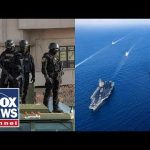
This pressure is already tangible at sea; U.S. forces recently disabled and seized an Iranian-flagged vessel attempting to run the blockade, showing that words are backed by action and that American sailors are enforcing rules that civilized commerce depends upon. The seizure underscores a simple conservative truth: deterrence requires the credible willingness to act, and when we act, adversaries pay a price. Our Navy and Marines are doing the hard, dangerous work to keep global trade lanes open and to protect the livelihoods of hardworking Americans who rely on stable markets.
Let there be no equivocation about responsibility: independent investigators and rights groups have documented what appears to be deliberate targeting of civilian ships in recent weeks, conduct that should be condemned in the strongest terms and treated as a provocation to international order. Iran’s Revolutionary Guard has repeatedly put commercial mariners in harm’s way, a pattern that cannot be tolerated if the West wishes to preserve the rules-based system that keeps seas safe. The world cannot treat merchant ships as acceptable collateral; those who attack civilians must be isolated and held to account.
This latest wave of attacks is not an isolated flare-up but part of a sustained campaign that has already disrupted dozens of transits through Hormuz and driven up energy costs worldwide, harming ordinary families and businesses. The pattern of assaults going back to March shows a calculated strategy to weaponize commerce, and it’s past time for free nations to coordinate an uncompromising response that combines military vigilance with financial chokeholds. America should lead that coalition proudly, not apologize for protecting trade routes that underpin our prosperity.
Patriotic Americans ought to demand a firm, consistent policy: defend our sailors, defend global shipping, and keep the pressure on bad actors until they choose the negotiating table over the missile launcher. Our country is safer when our leaders speak plainly and act decisively, and today the brave men and women of the U.S. military are buying the time diplomacy needs to work. Stand with them, insist on strength, and refuse the siren call of appeasement that always costs more in blood and treasure down the road.