Staff Reports
China has rushed to welcome the recently announced U.S.–Iran memorandum of understanding and, in the same breath, offered to “play an active role” in keeping the peace. That statement came from Foreign Ministry spokesman Lin Jian at the ministry’s regular briefing, and it is worth parsing — fast. With the deal aimed at reopening the Strait of Hormuz and creating a 60‑day window for follow‑on talks, Beijing’s public embrace of the agreement points to a bigger geopolitical play, not a kindly neighborly gesture.
Beijing’s public welcome — words that pack multiple meanings
At the ministry podium, Lin Jian said China “welcomes” the agreed text of the first‑stage memorandum, commended Pakistan Prime Minister Shehbaz Sharif’s mediation, and promised that China “will act on President Xi Jinping’s four propositions and play an active role” in restoring peace. Those are big words. They signal Beijing wants credit for stability in the Gulf while reminding everyone that China has both interests and influence in the region. The U.S. announcement — by President Donald Trump — and Iran’s own confirmation that the text was finalized and will be signed in Switzerland give the comments real weight. The practical question is what Beijing means by “active role.”
What “active role” probably means — and what it almost certainly doesn’t
Read the Chinese playbook and you see the likely answer: diplomatic face time, hosting talks, public diplomacy, and pressure via trade and investment channels. China’s “four propositions” emphasize dialogue, respect for sovereignty, and international law — fine slogans for a press release. What Beijing did not offer at the briefing was any concrete plan: no envoys named, no verification teams promised, no security guarantees for shipping lanes. That’s not surprising. China is a top buyer of Iranian oil and a diplomatic ally of Tehran, yet it also wants Gulf trade lanes open for its economy. So expect Beijing to seek influence and leverage, not to take on burdensome verification or hard security tasks.
Why the United States should be cautious — and lead, not follow
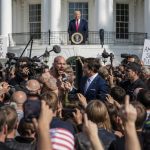
This is an American‑led agreement. President Donald Trump announced the deal and authorized the reopening of the Strait of Hormuz. Congress and the administration should treat Beijing’s offer as what it is: an attempt to claim a seat at the table. Washington should welcome diplomatic help from regional partners and from Pakistan, but it must not cede control over core security and verification steps to Beijing. That means demanding specificity — who will verify limits on Iran’s enrichment, how frozen assets will be handled, what enforcement mechanisms exist — before making permanent concessions. And yes, keep a credible naval presence until the mechanics are transparent. If China wants to “play an active role,” fine — name your envoys, show your verification plan, and sign up to independent oversight. Otherwise it’s just clever messaging.
What to watch next — red flags and checkpoints
Keep an eye on a few concrete developments: whether China names envoys or hosts follow‑up talks; whether the MoU text becomes public with enforceable verification steps; how Gulf states, Saudi Arabia and the UAE, respond to Beijing’s offer; and whether regional military incidents undercut the 60‑day window. Markets will keep reacting to uncertainty about oil flows. Above all, the United States should insist on transparency and independent verification of Iran’s nuclear activities and any sanctions relief. China can be useful as a diplomatic partner, but it cannot be allowed to dictate terms that affect American security or reward Iranian bad behavior.